
Energy demand across IT parks and corporate campuses in India continues to rise as businesses expand and operate round the clock. At the same time, organisations are under increasing pressure to meet sustainability targets, ESG commitments, and green building standards. Traditionally, solar adoption focused on rooftops, but limited space and growing energy needs are driving a shift toward more integrated solutions.
Solar facades offer a modern approach by embedding energy generation directly into building exteriors. This allows companies to optimise unused vertical surfaces while maintaining a clean, design-led aesthetic, making solar a visible and functional part of the architecture.
Find the right solar facade solution for your corporate campus.
A] What Are Solar Facades, and How Do They Function?
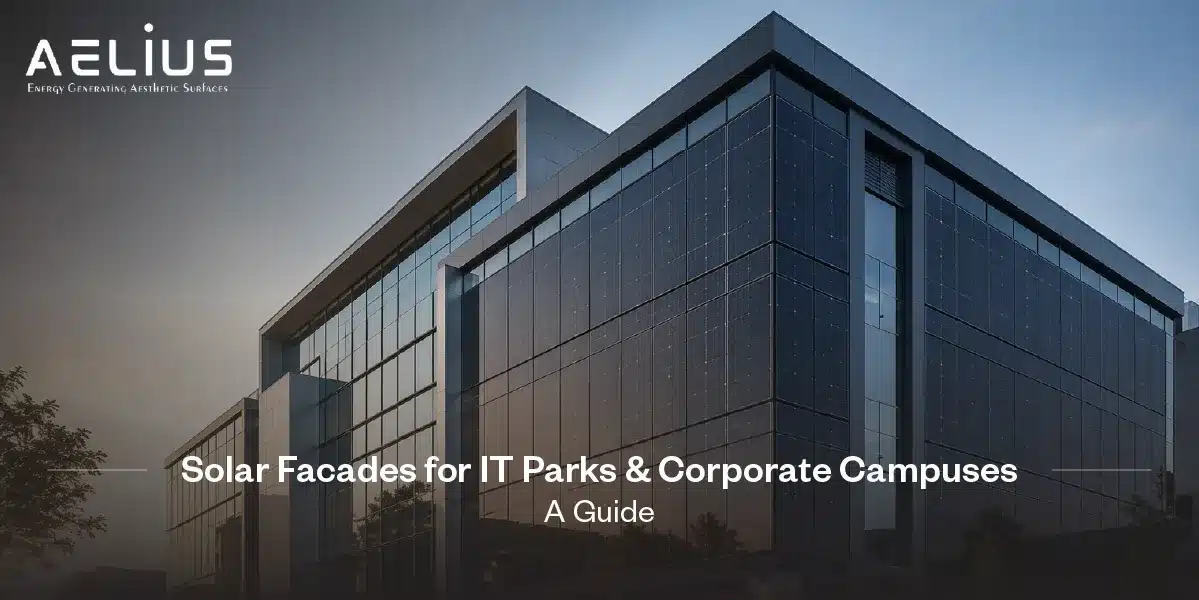
Solar facades, also known as solar panel facades, are photovoltaic systems integrated directly into a building’s exterior surfaces, such as walls or curtain facades. This approach is often explored further when designing with BIPV, where energy generation becomes an integral part of architectural expression rather than an added feature.
These systems use photovoltaic cells embedded within facade panels to capture sunlight and convert it into electricity. The generated power can be used within the building or supplied to the grid, depending on the system design.
Unlike conventional solar panels that are installed on rooftops or open spaces, solar facades are vertically positioned and designed to align with the building’s architecture. While their energy generation pattern may differ due to orientation, they make use of otherwise unused surfaces. This integration allows buildings to become more energy-efficient without compromising on design or space utilisation.
B] Where Can Solar Facades Be Used in Corporate Campuses?
Solar facades can be applied across multiple areas within corporate campuses, offering both functional and design benefits.
- Office Towers and Curtain Walls: Integrated into glass or solid facades, they transform building exteriors into energy-generating surfaces.
- Campus Buildings and Atriums: Suitable for large institutional blocks and shared spaces, helping distribute energy generation across the campus.
- Sky Bridges and Connectors: Solar panels can be incorporated into connecting structures, making even transitional spaces productive.
- Parking Structures and Walkways: Provide shade while generating power, improving usability and efficiency in outdoor areas.
- New Builds and Retrofit Projects: Can be planned during construction or integrated into existing buildings with the right design approach.
- Design Flexibility for Large Developments: Allows custom layouts and consistent design language across multiple buildings within a campus.
C] Why Are Solar Facades Ideal for IT Parks and Corporate Offices?
Solar facades offer several advantages that align well with the needs of IT parks and corporate campuses.
- Untapped Vertical Potential: Large building exteriors provide significant surface area for energy generation beyond rooftops.
- Reduced Grid Dependence: Helps lower reliance on conventional electricity sources, especially during peak usage hours.
- Enhanced Aesthetic Appeal: Integrates seamlessly into building design, supporting a modern and professional visual identity.
- Support for Green Certifications: Contributes to sustainability benchmarks under frameworks like LEED, IGBC, and GRIHA.
- Alignment with ESG Goals: Demonstrates commitment to environmental responsibility and long-term sustainability targets.
These benefits make solar facades a practical and forward-looking solution for organisations aiming to balance performance with design.
D] How Do Solar Facades Compare to Rooftop Solar in Commercial Spaces?
Both solar facades and rooftop systems play important roles in commercial energy strategies, but their applications differ.
- Space Utilisation: Rooftop solar is limited by available roof area, while facades use vertical surfaces that are often underutilised.
- Energy Generation Pattern: Rooftop panels are typically positioned for optimal sunlight exposure, whereas facades generate energy based on building orientation.
- Design Integration: Facades are seamlessly built into the structure, while rooftop systems are added as external installations.
- Complementary Use: In large campuses, both systems can be used together to maximise overall energy generation, often alongside off-site solutions such as solar parks to meet higher energy demands.
- Suitability: Rooftop solar is ideal for low-rise buildings, while facades are more effective in high-rise and dense developments.
Choosing between the two or combining both depends on project scale, design priorities, and energy requirements.
E] What ROI and Performance Benefits Can Solar Facades Deliver?
Solar facades offer long‑term financial and operational benefits for large‑scale commercial and campus developments.
- Energy Cost Savings: Reduces electricity expenses over time by generating on-site renewable energy.
- Lower Peak Load Demand: Helps manage energy consumption during high-demand periods, improving efficiency.
- ESG and Reporting Value: Supports sustainability reporting and strengthens corporate environmental credentials.
- Enhanced Asset Value: Improves building appeal for tenants and investors seeking sustainable infrastructure.
- Payback Considerations: While initial costs may be higher, long-term savings and material integration contribute to overall returns.
When planned effectively, solar facades can deliver both financial and environmental value.
Speak with our experts to evaluate your building’s solar potential.
Conclusion
Solar facades are emerging as a powerful solution for IT parks and corporate campuses, combining energy generation with architectural design. They go beyond traditional solar systems by utilising vertical surfaces and integrating seamlessly into building structures. As sustainability becomes a priority in commercial real estate, its relevance continues to grow across business districts in India.
With increasing adoption and advancements in technology, solar facades offer a scalable approach to meeting energy and ESG goals. To explore how solar facades can be integrated into your project, contact us at Aelius for expert guidance on solutions aligned with your building and sustainability objectives.

Mr. Ankit Modi
Mr. Ankit Modi is the Founder & CEO of Aelius, driving innovation in Building-Integrated Photovoltaics (BIPV) and solar design. With a Master’s in Renewable Energy and Architecture from Nottingham University, UK, and 18+ years of experience in renewable energy and solar solutions, he brings together architectural sensitivity and technical precision. As a Certified Low Carbon Consultant with CIBSE (UK), he brings a strong focus on sustainable building practices and renewable integration. He is also associated with BREEAM (UK), IGBC, and GRIHA, supporting his vision for low-carbon architecture.