

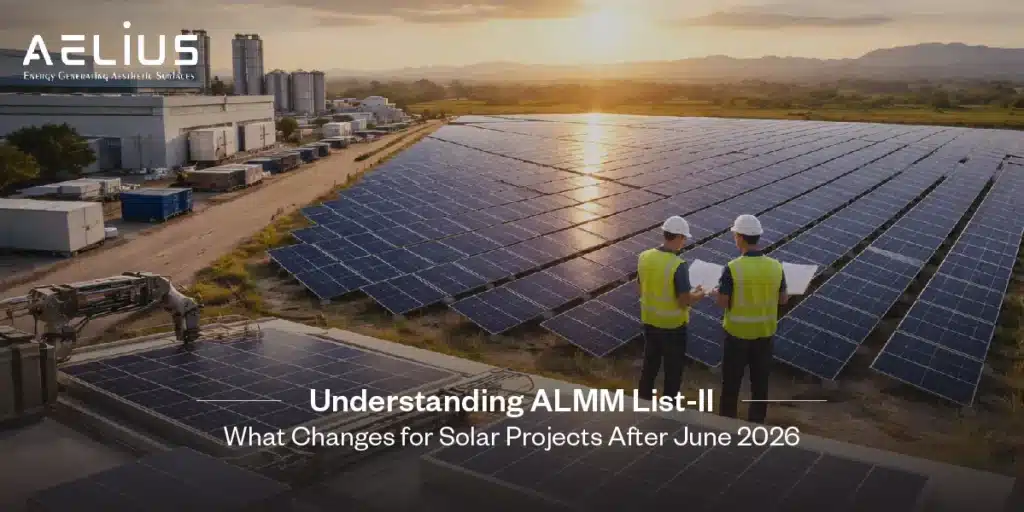
India’s solar sector is entering another important transition phase with the implementation of ALMM List-II for solar cells from June 2026. The Approved List of Models and Manufacturers (ALMM) framework was introduced to strengthen quality standards and support domestic solar manufacturing. While ALMM List-I already applies to solar modules, the upcoming List-II requirement for solar cells is expected to influence procurement planning, project costs, and execution timelines across the industry.
For developers, EPC contractors, and commercial solar buyers, understanding these changes early will be important as India continues to prioritise energy security and local manufacturing growth.
Get expert guidance on ALMM-ready solar project planning
A] What Is the ALMM List-II and Why Is It Becoming Important in 2026?
The ALMM framework was introduced by the Ministry of New and Renewable Energy (MNRE) to promote approved and quality-compliant solar equipment for projects connected to government-backed schemes and approvals.
MNRE has clarified that ALMM for solar cells becomes mandatory one month after the publication of the first ALMM List‑II, but the effective date for projects (commissioned from 1 June 2026) remains the same. This means projects falling under applicable categories may need to use domestically approved solar cells for compliance.
The move aligns with India’s larger goal of reducing dependence on imported solar components and strengthening local manufacturing capabilities. Over the last few years, the government has increased its focus on building a self-reliant solar supply chain to support long-term energy security. This growing domestic ecosystem is also expected to support innovation in specialised solar products, including custom solar modules and BIPV applications.
In most cases, ALMM rules mainly apply to projects availing government subsidies, net-metering approvals, open-access permissions, or scheme-linked benefits unless exemptions are specifically announced by the MNRE.
B] How Will the New Rule Affect Solar Project Timelines and Procurement?
The transition to ALMM List-II may create short-term procurement and execution challenges across the solar industry, especially during the initial implementation phase. Some key areas likely to be affected include:
- Approved Cell Availability: Domestic manufacturing capacity for ALMM-approved solar cells may initially remain limited compared to market demand.
- Procurement Delays: Developers could face longer lead times while securing compliant cells and modules for upcoming projects.
- Pricing Fluctuations: Limited supply and increased demand may temporarily influence module pricing and procurement costs.
- Inventory Planning: EPC contractors and project developers may need stronger inventory forecasting to avoid execution disruptions.
- Vendor Alignment: Early coordination with approved suppliers could become important before project bidding and planning stages.
Projects that were bid out before December 9, 2024, when MNRE issued the ALMM List-II order, are exempt from the solar cell requirement, even if commissioning happens after June 2026.
C] Which Solar Segments Could See the Biggest Impact After June 2026?
The impact of ALMM List-II is expected to vary across different solar segments, depending on their connection to government approvals, schemes, and procurement structures. Key segments likely to see the biggest impact include:
- Utility-Scale Solar Projects: Large projects linked to government tenders and power purchase agreements will likely require strict ALMM compliance.
- Commercial & Industrial (C&I) Installations: Projects dependent on net metering or open-access approvals will need approved domestic cells and modules.
- PM-KUSUM Projects: Agricultural and rural solar deployments under government-supported schemes are also expected to follow ALMM regulations.
Residential rooftop projects may also indirectly experience pricing or supply-chain impacts as domestic sourcing requirements influence overall module availability and costs.
D] What Challenges and Opportunities Could the ALMM List-II Rule Create?
1. Challenges
- Higher Initial Costs: Domestic sourcing requirements could temporarily increase module and cell procurement costs; DCR modules are currently ~70% more expensive than non‑DCR modules, which particularly affects C&I rooftop and ground‑mount projects.
- Supplier Dependence: Developers may initially rely on a smaller pool of approved domestic manufacturers.
- Execution Pressure: Ongoing projects may face tighter timelines if procurement planning is delayed.
2. Opportunities
- Growth in Domestic Manufacturing: The policy may encourage faster expansion of India’s solar cell manufacturing capacity.
- Improved Supply-Chain Stability: Reduced import dependence can help strengthen long-term procurement reliability.
- Technology Investments: Increased local production may drive investment in better manufacturing technologies and quality standards.
- Stronger Solar Ecosystem: Over time, the industry could benefit from a more integrated and self-sustaining domestic supply chain that supports areas such as BIPV manufacturing, solar cells, and module production.
The transition period may require careful planning, but it also reflects India’s broader clean-energy and manufacturing ambitions.
E] How Can Solar Developers and Businesses Prepare Before June 2026?
With the June 2026 implementation timeline approaching, early preparation may help developers and businesses minimise procurement risks and project delays. A few important areas to focus on include:
- Early Procurement Planning: Identifying approved suppliers and forecasting component requirements in advance can support smoother execution.
- Technical Due Diligence: Evaluating supplier capability, compliance readiness, and product quality may become increasingly important.
- Stronger Vendor Partnerships: Working closely with experienced EPC and turnkey solution providers can improve procurement coordination.
- Execution Readiness: Project schedules may need additional flexibility to account for supply-chain transitions during the early phase of implementation.
Simplify ALMM compliance and solar procurement planning
Conclusion
ALMM List-II is expected to reshape how many solar projects in India are planned, sourced, and executed after June 2026. While the transition may bring short-term procurement and pricing challenges, it also represents a major step toward strengthening India’s domestic solar manufacturing ecosystem.
For developers, EPC contractors, and businesses involved in government-linked or approval-dependent solar projects, early preparation will be important to avoid delays and compliance-related risks. Aelius, a turnkey EPC provider with ALMM-compliant manufacturing capabilities, can support businesses with procurement planning, compliance readiness, and end-to-end project execution aligned with evolving industry regulations. Businesses seeking guidance for upcoming solar projects can contact us to discuss their requirements. As India continues accelerating its clean-energy goals, strategic planning and reliable partnerships will play an important role in future-ready solar development.
FAQs
1. Which solar projects are covered under ALMM rules?
ALMM rules mainly apply to projects linked to government schemes, subsidies, net-metering approvals, open-access approvals, and government tenders. Coverage may vary depending on specific MNRE notifications and exemptions.
2. Can existing projects get an exemption?
Yes, some projects may qualify for exemptions based on government notifications or bidding timelines. Projects bid out before December 9, 2024 are exempt from the ALMM List-II solar cell requirement, even if commissioned after June 2026.
3. What documents are required for exemption?
Exemption requirements may include bid documents, tender issuance dates, power purchase agreements, project approvals, and other supporting compliance records. The exact documentation depends on MNRE guidelines and the project category.
4. Will ALMM List-II apply to rooftop solar (residential, commercial, and industrial)?
ALMM List-II is expected to apply mainly to rooftop solar projects linked to subsidies, net metering, or government-supported approvals. Residential, commercial, and industrial projects may be impacted differently depending on their regulatory structure.
5. How does ALMM affect solar project costs?
ALMM requirements may temporarily increase procurement costs due to dependence on approved domestic suppliers and limited initial supply. Over time, stronger local manufacturing could help improve supply-chain stability and pricing consistency.

Mr. Ankit Modi
Mr. Ankit Modi is the Founder & CEO of Aelius, driving innovation in Building-Integrated Photovoltaics (BIPV) and solar design. With a Master’s in Renewable Energy and Architecture from Nottingham University, UK, and 18+ years of experience in renewable energy and solar solutions, he brings together architectural sensitivity and technical precision. As a Certified Low Carbon Consultant with CIBSE (UK), he brings a strong focus on sustainable building practices and renewable integration. He is also associated with BREEAM (UK), IGBC, and GRIHA, supporting his vision for low-carbon architecture.