

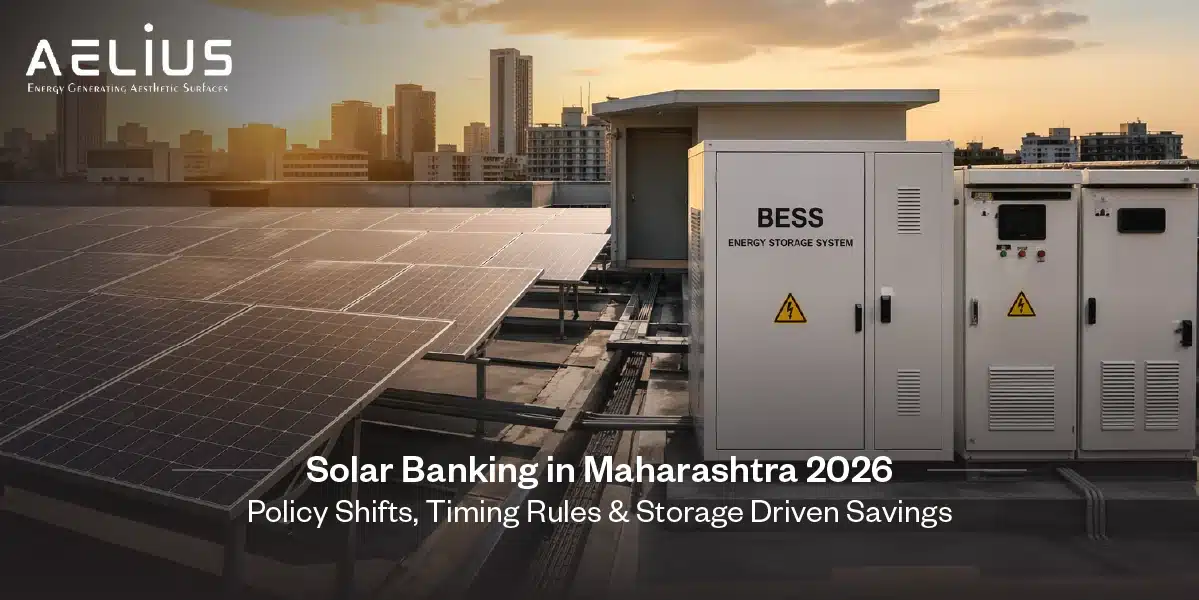
Solar savings in Maharashtra is no longer defined by how much energy you generate but by how effectively you use it. Many businesses still rely on older solar banking assumptions, expecting consistent returns from exporting excess power. However, 2026 brings important changes, including revised banking rules limited to the same Time-of-Day (ToD) slot withdrawals, ToD tariffs, and a stronger focus on energy storage. Aelius, a trusted BIPV-centric solar EPC company with Ministry of New and Renewable Energy (MNRE) empanelment, helps clients adapt through turnkey solutions that integrate generation, storage, and optimisation for superior financial outcomes.
Solar banking is no longer a standalone solution; it is now part of a broader energy strategy that combines smart consumption, timing, and storage integration to optimise financial returns.
Explore smarter solar and storage solutions for better cost efficiency
A] What Is Solar Banking and How Does It Work?
Solar banking allows users to export excess solar power to the grid and use it later when needed. It works like a credit system, when your system generates more electricity than you consume, the surplus is “banked” within the grid. You can then draw this energy during periods when your solar system is not generating enough. At its core, solar banking involves two simple actions:
- Export surplus energy: Excess power generated during the day is sent to the grid.
- Withdraw later: Stored credits are used when demand exceeds generation.
However, this system operates within Maharashtra’s 2026 policy limits, including same-ToD slot settlement cycles (e.g., daytime exports usable only in daytime) and usage caps.
B] Key Changes in Maharashtra’s Solar Banking Rules (2026 Update)
Maharashtra’s 2026 policy introduces notable shifts that directly impact how solar banking works. Earlier, exporting excess energy was a reliable way to offset costs. Now, the structure has evolved:
- Reduced banking benefits: Exported energy credits are restricted to the same ToD slot (e.g., 09:00–17:00 exports usable only then) or paid at a low fixed rate of ₹2.82/kWh, cutting returns significantly.
- Greater focus on self-consumption: Users are encouraged to use solar power instantly.
- Integration with ToD tariffs: Energy value now depends on when it is used.
These changes make excess exports less financially attractive. Businesses can pivot to behind-the-meter consumption and hybrid BESS systems, minimising low-value exports while storing energy for peak ToD slots to boost savings.
This reflects a clear transition in solar economics, from volume-based savings to time-based efficiency. To stay cost-effective, users must rethink their approach and move beyond traditional dependence on grid banking.
C] How Time-of-Day (ToD) Tariffs Impact Your Savings
Time-of-Day (ToD) tariffs introduce variable electricity pricing based on demand, with lower rates during off-peak hours and higher rates during peak periods (typically 17:00–00:00).
This affects solar users in the following ways:
- Daytime generation vs evening demand: Solar systems produce most energy during the day (09:00–17:00), while consumption often peaks in the evening.
- Higher peak costs: Drawing grid power during peak hours increases overall electricity expenses.
- Lower export value: Energy exported during the day may not fully offset higher-cost consumption during peak periods.
As a result, relying on solar banking alone becomes less effective. The mismatch between when energy is generated and when it is consumed reduces overall savings. To maximise value, users must better align consumption with generation, making storage and load optimisation increasingly important.
D] Role of Storage: Why BESS Is Becoming Essential
Energy storage is emerging as a key solution to maximise the value of solar power. Instead of exporting excess energy to the grid, users can store it and use it later when electricity is more expensive.
A Battery Energy Storage System (BESS) enables this by storing surplus energy generated during the day and releasing it during peak-demand hours. The benefits are clear:
- Store daytime excess: Capture unused solar energy instead of exporting it.
- Use during peak tariffs: Reduce reliance on expensive grid power, as storage enables energy arbitrage, where electricity is stored at low cost and used when prices are higher.
- Minimise banking dependency: Lower exposure to reduced banking benefits.
Maharashtra’s 2026 policy now expects new renewable energy projects over 100 kW to include battery storage, typically around 50% of their capacity with at least 2 hours of backup. This starts from April 2026 and helps align solar generation with evening usage patterns.
E] Solar Banking vs Behind-the-Meter & Off-Grid Systems
As policies evolve, users are exploring alternatives to traditional solar banking. Each approach offers different benefits depending on energy needs. Here’s a simple comparison:
| Approach | Pros | Cons |
| Solar Banking | Grid flexibility | Reduced returns |
| Behind-the-Meter | Direct use, high savings | Load alignment needed |
| Off-Grid | Independence | High upfront cost |
Maharashtra’s shift toward self-consumption reflects a broader move toward hybrid systems that combine solar with storage.
For industries with predictable loads, behind-the-meter solutions work well. Smaller or remote setups may benefit from off-grid systems. Choosing the right approach depends on usage patterns, cost priorities, and long-term goals.
F] Practical Strategies to Maximise Savings in 2026
To adapt to the new energy landscape, users need a more strategic approach. Here are some practical ways to improve savings:
- Align load with generation: Schedule high-energy activities (09:00–17:00) during solar peaks.
- Integrate BESS solutions: Use stored energy during peak tariffs (17:00–00:00).
- Reduce reliance on banking: Minimise excess exports to avoid low-value returns.
- Analyse consumption patterns: Identify when and how energy is used to optimise efficiency.
- Adopt smart energy systems: Use monitoring tools for better control and decision-making.
While these strategies may require initial planning or investment, they offer stronger long-term returns. Instead of focusing only on installation, the emphasis should be on optimisation.
Solution providers such as Aelius, a trusted manufacturer of BIPV and turnkey solar solutions, are enabling this transition by offering integrated systems that combine generation, design, and efficiency. Those interested can know more about their approach and expertise here.
Understand how to optimise your solar savings under the new policy
Conclusion
Solar banking in Maharashtra is no longer the sole driver of savings. The shift toward smarter energy usage, combined with solar-BESS systems and EPC solutions, is reshaping how solar delivers value. Simply generating power is not enough, how and when you use it now matters just as much.
Integrated systems that combine solar, storage, and intelligent consumption offer the best financial outcomes. As the state moves toward a more efficient and sustainable energy future, adapting to these changes is essential. Aelius helps simplify this transition by assessing energy loads, interpreting evolving policies, and designing hybrid solar-BESS solutions built for peak savings and compliance. To explore tailored solutions and optimise your solar strategy, contact us for further guidance.

Mr. Ankit Modi
Mr. Ankit Modi is the Founder & CEO of Aelius, driving innovation in Building-Integrated Photovoltaics (BIPV) and solar design. With a Master’s in Renewable Energy and Architecture from Nottingham University, UK, and 18+ years of experience in renewable energy and solar solutions, he brings together architectural sensitivity and technical precision. As a Certified Low Carbon Consultant with CIBSE (UK), he brings a strong focus on sustainable building practices and renewable integration. He is also associated with BREEAM (UK), IGBC, and GRIHA, supporting his vision for low-carbon architecture.