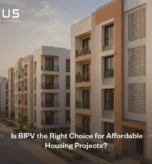

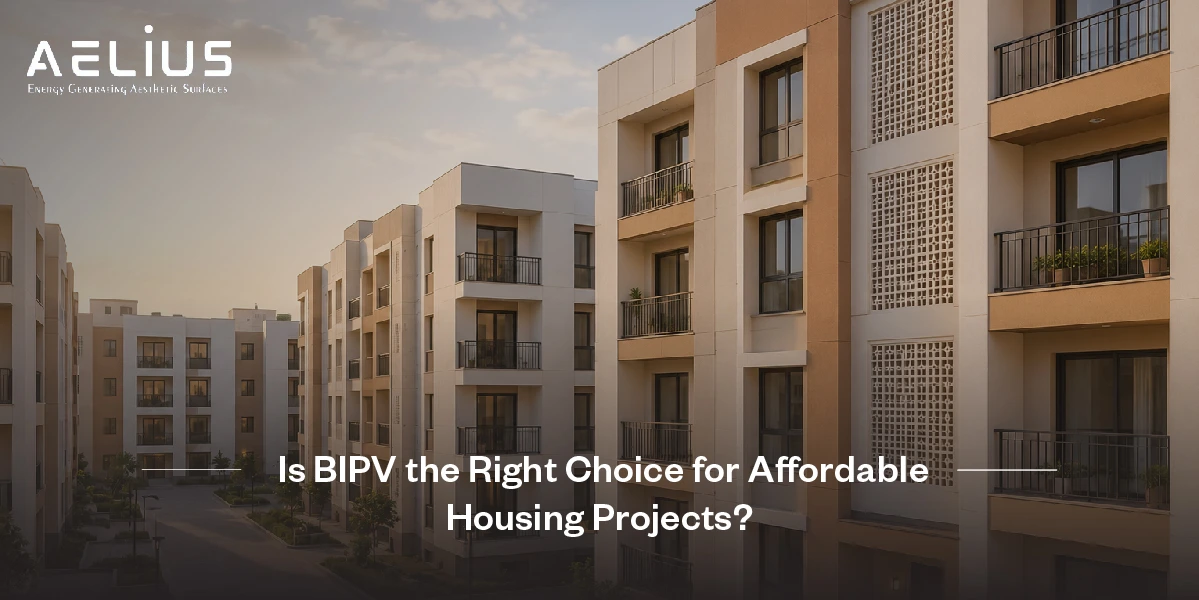
India’s growing population and rapid urbanisation are driving demand for affordable housing while the country continues to move towards cleaner energy. As housing projects expand, developers are also looking for practical ways to manage long-term electricity costs and improve energy efficiency. Building-Integrated Photovoltaics (BIPV) offer one possible solution by combining solar energy generation with essential building elements such as facades, roofs, and balconies. Unlike conventional solar systems that are added after construction, BIPV is incorporated into the building design itself. With advancements in solar technology, design, and manufacturing, BIPV is becoming increasingly relevant for affordable housing projects.
Explore BIPV Solutions for Your Affordable Housing Project
A] What Is BIPV and How Does It Work in Affordable Housing?
Building-Integrated Photovoltaics (BIPV) are solar systems designed to become part of a building’s structure while generating electricity from sunlight. Instead of installing conventional solar panels separately on a rooftop, BIPV solutions can replace or complement materials used in the building envelope. For affordable housing projects, BIPV can be integrated into different parts of the building:
- Solar Facades: Solar modules can be incorporated into external walls and facade elements, highlighting the growing role of BIPV and solar panel manufacturing in developing integrated solutions for modern residential buildings.
- Solar Roofing: Solar modules can form part of the roof itself, combining weather protection with renewable energy generation.
- Balcony Solar Systems: Balcony-integrated solar solutions can suit apartment-based affordable housing projects by agencies such as MHADA and MMRDA, particularly where rooftop space is limited. Applicable subsidies or incentives may further support large-scale adoption.
Planning BIPV during the design stage allows developers to make better use of available surfaces and coordinate solar generation with the building’s architecture. Designing with BIPV from the outset can be particularly valuable in high-density developments where open rooftop space may be limited.
B] Why Is BIPV Becoming Relevant for Affordable Housing Projects?
For affordable housing, the value of BIPV goes beyond environmental benefits. When planned appropriately, it can help address practical concerns such as energy costs, limited space, and the visual impact of solar installations.
- Lower Energy Costs: Generating electricity on-site can help reduce dependence on grid-supplied power and potentially lower long-term electricity expenses.
- Better Space Utilisation: BIPV makes use of existing building surfaces, including roofs, facades, and balconies, without requiring additional land.
- Reduced Energy Dependence: On-site solar generation can reduce reliance on conventional electricity sources and support greater energy resilience.
- Improved Aesthetics: BIPV can be designed as part of the building envelope, creating a more integrated appearance than conventional rooftop systems.
- Sustainable Development: Incorporating renewable energy into housing projects can support broader goals for energy-efficient and sustainable urban development.
- Suitable for High-Density Housing: BIPV can help maximise solar generation in residential projects where land availability and rooftop space are often limited. The Indian BIPV roadmap and case studies also provide useful context on policy, implementation, and real-world applications.
C] Can Government-Led Affordable Housing Projects Benefit from BIPV?
Government-led housing developments can be well suited to BIPV, particularly when solar integration is considered as part of the overall project design and planning process.
- Large-Scale Deployment: Projects with multiple buildings and standardised layouts can support repeatable BIPV designs, making large-scale implementation more practical.
- Renewable Energy Incentives: Applicable government incentives or subsidies, where available, may help improve the financial feasibility of integrating solar technology into affordable housing.
- Balcony Solar Systems: Balcony-integrated solar solutions can provide additional generation capacity for apartment-based housing where shared rooftop space is limited.
- Lower Energy Dependence: On-site solar generation can help reduce reliance on conventional electricity and potentially lower long-term energy costs for housing developments.
Government-led projects may benefit from scale, standardisation, and possible incentive alignment. However, factors such as project design, funding, solar exposure, applicable regulations, and energy requirements should be assessed during the planning stage to determine the most practical BIPV approach.
D] Where Can BIPV Be Integrated in Affordable Housing Projects?
One of the main advantages of BIPV is its flexibility. Depending on the building design and available solar exposure, different parts of an affordable housing project can be used for solar integration.
- Rooftops: Solar roofing systems can generate electricity while serving as an integral part of the building’s roof structure.
- Building Facades: Suitable facade surfaces can incorporate solar modules without requiring additional land or usable space.
- Balconies: Solar modules can be integrated into balcony railings or other suitable areas, making them relevant for apartment-based housing with limited rooftop space.
- Common Areas: Where appropriate, BIPV can support electricity requirements for shared facilities such as corridors, lighting, community spaces, and other amenities.
- Prefabricated Housing: Emerging solutions are exploring the integration of solar generation and battery storage into prefabricated housing systems, potentially supporting more energy-efficient construction.
The right combination will depend on the project’s architecture, orientation, energy needs, and available surfaces.
E] What Should Developers Consider Before Choosing BIPV?
BIPV can offer long-term value, but it requires careful planning to ensure the system is technically suitable and financially practical. Developers should consider the following factors before making a decision:
- Building Orientation: The positioning of the building affects sunlight availability and the potential energy generation of integrated solar surfaces.
- Solar Exposure: Shading from nearby buildings, trees, and other structures should be assessed to understand expected system performance.
- System Design: The BIPV solution should be selected based on the building’s architecture, energy requirements, structural considerations, and local conditions.
- Lifecycle Costs: Developers should evaluate long-term energy savings, maintenance, and replacement costs alongside the initial investment.
- Maintenance Needs: Access for cleaning, inspection, repairs, and future component replacement should be considered during the design stage.
- Early Integration: Planning BIPV before construction can simplify coordination and reduce the challenges of retrofitting solar systems later.
- Experienced Providers: Working with an experienced BIPV manufacturer or solution provider can support better system design, integration, installation, and long-term performance.
Developers can also compare BIPV and solar panels for design, cost, and performance to determine which approach best suits their project’s requirements.
Planning an Energy-Efficient and Sustainable Housing Project?
Conclusion
BIPV is becoming an increasingly viable option for affordable housing projects that aim to combine energy generation with efficient building design. By integrating solar technology into roofs, facades, and balconies, developers can make better use of available surfaces while supporting long-term energy goals. However, BIPV is not a one-size-fits-all solution. Its suitability depends on factors such as project scale, building orientation, solar exposure, design, budget, and energy objectives. Aelius, a manufacturer of BIPV and turnkey solar solutions, can help developers evaluate these factors and achieve optimal system integration, long-term performance, and project-specific design support. Contact us to explore BIPV solutions for your next affordable housing project.
FAQs
1. Is BIPV suitable for affordable housing developments?
Yes, BIPV can be suitable for affordable housing developments where building design, solar exposure, energy needs, and project costs support its integration.
2. Can BIPV be integrated into low-rise residential buildings?
Yes, BIPV can be integrated into low-rise residential buildings through applications such as solar roofing, facades, and suitable balcony systems.
3. What maintenance is required for BIPV systems?
BIPV systems generally require periodic cleaning, inspections, and maintenance of electrical components to ensure reliable long-term performance.
4. Is BIPV more expensive than traditional solar panels?
BIPV can have higher upfront costs because solar technology is integrated with building materials and construction. However, it may offer long-term value through energy generation and efficient use of building surfaces.
5. What factors should developers consider before installing BIPV in affordable housing?
Developers should consider building orientation, solar exposure, system design, lifecycle costs, maintenance, and early integration during planning. Contact us to discuss a BIPV solution suited to your project’s requirements.

Mr. Ankit Modi
Mr. Ankit Modi is the Founder & CEO of Aelius, driving innovation in Building-Integrated Photovoltaics (BIPV) and solar design. With a Master’s in Renewable Energy and Architecture from Nottingham University, UK, and 18+ years of experience in renewable energy and solar solutions, he brings together architectural sensitivity and technical precision. As a Certified Low Carbon Consultant with CIBSE (UK), he brings a strong focus on sustainable building practices and renewable integration. He is also associated with BREEAM (UK), IGBC, and GRIHA, supporting his vision for low-carbon architecture.