

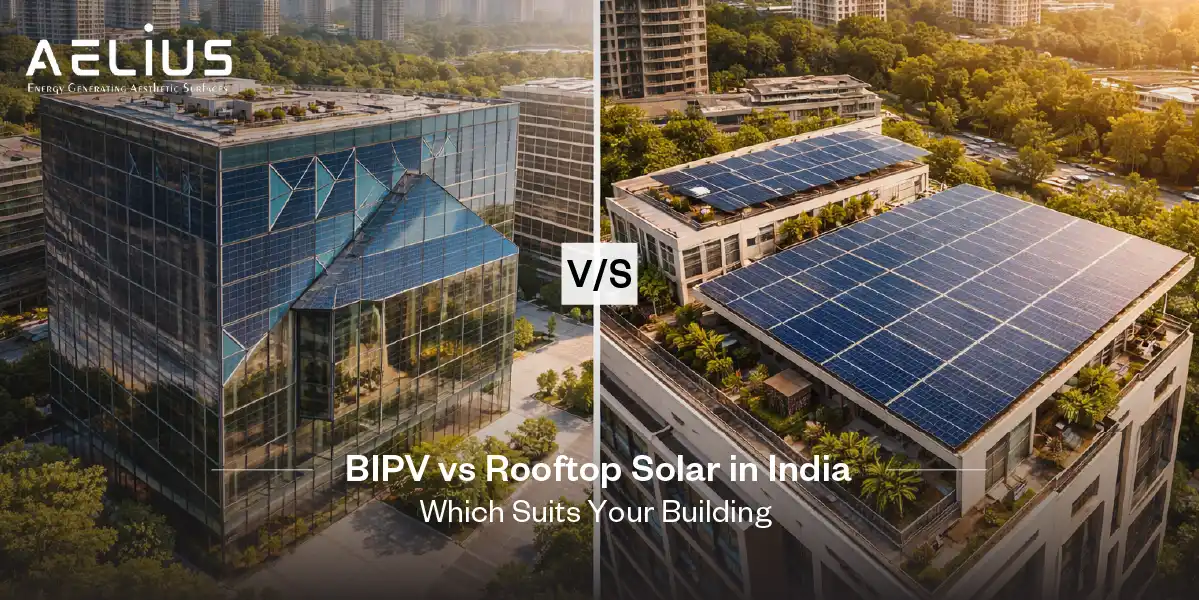
Solar energy adoption in India has grown rapidly across residential, commercial, and industrial spaces. As more property owners look to reduce energy costs and improve sustainability, choosing the right solar solution becomes an important decision. A common dilemma today is whether to opt for traditional rooftop solar systems or explore newer, integrated options like BIPV (Building-Integrated Photovoltaics).
While both generate clean energy, they differ significantly in design, installation, and application. In this blog, we will explore key differences between BIPV and rooftop solar, focusing on cost, efficiency, design flexibility, and suitability that can help you determine which option aligns best with your building and long-term goals.
Explore the right solar approach for your project requirements.
A] What Is Rooftop Solar, and How Does It Work?
Rooftop solar systems are the most widely used form of solar installation in India. These systems involve mounting photovoltaic panels on the roof of an existing building to generate electricity from sunlight. They are typically installed on flat or sloped roofs using support structures that optimise panel orientation for maximum sunlight exposure.
A standard rooftop solar setup includes solar panels, inverters, mounting structures, wiring, and, in some cases, battery storage. The panels capture sunlight and convert it into electricity, which is then used to power the building or fed back into the grid through net metering.
Rooftop systems are commonly used in homes, offices, factories, and warehouses due to their straightforward installation and proven performance. Their biggest advantage lies in their simplicity, making them a practical and familiar choice for most users.
B] What Are BIPV Solar Panels, and How Are They Different?
BIPV solar panels are designed to be an integral part of the building rather than an add-on. Instead of being mounted on top of a structure, these panels are incorporated directly into architectural elements such as roofs, facades, skylights, or shading systems.
This integration allows BIPV systems to serve a dual purpose. They function as building materials while also generating electricity. As a result, they contribute to both the structural and energy performance of a building.
One of the key differences lies in design flexibility when designing with BIPV. BIPV panels can be customised in terms of size, layout, and finish, enabling architects to align them with the overall design vision. While still an emerging solution in India, BIPV is increasingly being adopted in premium residential projects, commercial developments, and high-rise buildings where aesthetics and space optimisation are important considerations.
C] How Do BIPV and Rooftop Solar Compare in Cost and Efficiency?
Both systems offer long-term energy benefits, but they differ in cost structure and performance factors.
- Initial Cost: Rooftop solar systems are generally more affordable upfront, making them accessible for a wider range of projects. BIPV systems involve higher initial investment due to customisation and integration.
- Long-Term Value: BIPV can offset the cost of conventional building materials while generating energy, offering combined value over time.
- Efficiency Factors: Rooftop panels are often installed at optimal angles, which can improve energy output. BIPV systems may have design constraints depending on building orientation.
- Heat and Performance: Rooftop systems typically allow better airflow, which can help maintain efficiency in hot climates. BIPV performance depends on integration design and material choice.
- Maintenance: Rooftop systems are easier to access and maintain. BIPV systems may require more planning for maintenance due to their integrated nature.
Overall, rooftop solar is more cost-effective initially, while BIPV offers long-term design and material advantages.
D] Which Option Is Better for Indian Buildings and Climate?
The choice between BIPV and rooftop solar depends on building type, location, and regulatory conditions. Rooftop solar systems are widely suited for independent houses, factories, and warehouses where sufficient roof space is available. Their flexibility makes them ideal for retrofitting existing buildings across both urban and semi-urban areas.
BIPV systems are better suited for dense urban environments, particularly in high-rise buildings and design-focused developments where space is limited. In cities like Mumbai, Delhi, and Bangalore, where usable roof area is often restricted, integrating solar into facades or structural elements can be more practical.
Climate conditions across India, including high heat, dust, and heavy monsoons, also influence system performance. Rooftop systems are easier to clean and maintain, while BIPV requires careful planning during the design stage.
Additionally, solar adoption varies by state due to differences in net metering policies, approval processes, and DISCOM regulations. Understanding these local factors is essential when choosing the most suitable solar solution.
E] Key Factors When Choosing Between BIPV and Rooftop Solar
- Budget and Scale: Rooftop solar is more budget-friendly for most projects, while BIPV suits projects with higher design investment and planning flexibility.
- Stage of Construction: Rooftop systems are ideal for existing buildings and retrofits, whereas BIPV is best planned during early stages of new construction projects.
- Aesthetic Requirements: BIPV offers seamless integration for design-focused projects, unlike conventional rooftop panels that may appear visually separate from the structure.
- Energy Needs: Larger energy demands may favour rooftop installations with optimal panel positioning and higher generation efficiency across available roof space.
- Sustainability Goals: Both support clean energy, but BIPV contributes more holistically by integrating with the building envelope and overall design strategy.
Get expert guidance on choosing between BIPV and rooftop solar.
Conclusion
Both BIPV and rooftop solar systems offer valuable pathways to adopting clean energy, but they serve different purposes. Rooftop solar remains a practical and cost-effective solution for most buildings, especially where ease of installation is a priority. BIPV, on the other hand, represents a more integrated and design-driven approach, ideal for projects that prioritise aesthetics and long-term value.
There is no one-size-fits-all solution. The right choice depends on your building type, budget, and design goals. To make an informed decision and explore the best-fit solution for your project, contact us for expert guidance from Aelius on solar integration aligned to your needs.

Mr. Ankit Modi
Mr. Ankit Modi is the Founder & CEO of Aelius, driving innovation in Building-Integrated Photovoltaics (BIPV) and solar design. With a Master’s in Renewable Energy and Architecture from Nottingham University, UK, and 18+ years of experience in renewable energy and solar solutions, he brings together architectural sensitivity and technical precision. As a Certified Low Carbon Consultant with CIBSE (UK), he brings a strong focus on sustainable building practices and renewable integration. He is also associated with BREEAM (UK), IGBC, and GRIHA, supporting his vision for low-carbon architecture.