
Not too long ago, solar panels were treated as an afterthought, installed on rooftops with little consideration for design. Today, the approach is changing quickly. Architects and producers want buildings that are both energy-efficient and attractive.
Here’s where building-integrated photovoltaics (BIPV) come in. BIPV allows solar technology to become part of the building itself instead of adding solar panels later. Above all, it adds design flexibility to the equation.
With the use of custom colours, textures and finishes, modern architectural solar panels can also be designed to match design intent as well as produce energy with loss. Companies like Aelius are leading this shift in India by offering fully integrated, design-led BIPV solutions.
Ready to bring design-led solar into your next project?
A] What is BIPV, and How Does It Enable Design Freedom?
Building-integrated photovoltaics refers to a solar technology that is integrated into a building’s design. Building-integrated solar panels differ from rooftop systems in that they are not an installation that sits on top of a building. They are not something that is added on but instead are used instead of the glass, cladding, or roof material on the building.
BIPV panels may be seamlessly integrated into facades, skylights, roofs, and curtain walls. Instead of sitting on top of a building’s roof, the panels are integrated into the building envelope.
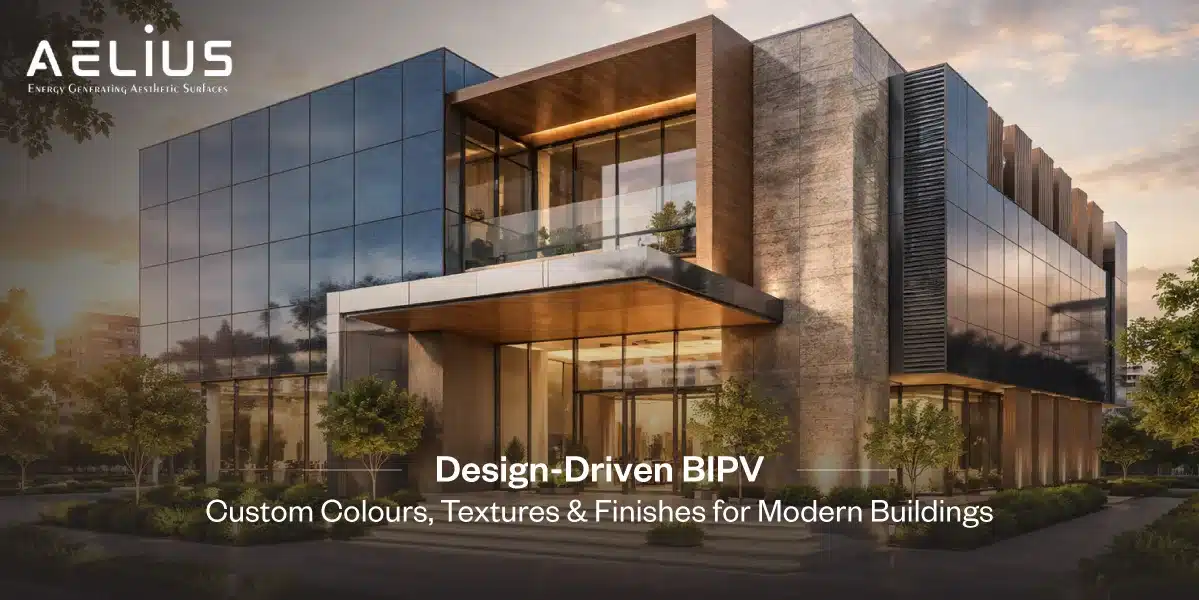
BIPV offers considerable design freedom, which makes it all the more interesting. Architects may now utilise a variety of coloured panels. It is possible to customise a building’s aesthetics with cutting-edge BIPV glass panels and BIPV solar modules.
It is challenging to maintain a balance between aesthetics and efficiency. Tailoring can have an impact on the output of energy, but only with the right experience. BIPV manufacturers like Aelius can make sure that the choices made do not compromise functionality and performance.
B] How Can BIPV Be Customised with Colours for Modern Buildings?
The ability to change colours is one of the greatest benefits of building integrated solar panels. This is particularly relevant for architects who want a solution that respects, complements, or enhances the building’s visual identity.
The modern design of BIPV panels can be made in solid colours, which allows the facades to look uniform. From commercial buildings with neutral tones to design-focused undertakings in brighter shades, colour flexibility is now possible with BIPV.
Another customisation option is colour-matched solar facades. For corporate offices or branded spaces, this opens an opportunity to match the surface with the company colours without sacrificing sustainability goals.
However, colour customisation comes at a cost. Darker colours tend to absorb more sunlight, which obviously performs better, while lighter or custom colours can affect performance a bit.
With the right guidance from companies such as Aelius, architects can strike the right balance between design and energy requirements.
C] What Texture Options Are Available in BIPV Panels?
Beyond colour, the texture plays a crucial role in creating the overall impression of a building. Today’s BIPV glass panels have a wide range of textures that go far beyond traditional smooth finishes.
Smooth glass surfaces are still much in vogue, especially for modern commercial buildings where linearity and reflections are preferred. However, textured finishes are gaining more popularity for projects that seek a more visual depth.
Architects can now choose from matte surfaces, patterned designs, and even textures that mimic materials like stone, metal, or ceramic. These options allow architectural solar panels to fit in with various types of facades.
The surface texture impacts the behaviour of light upon contact. Certain finishes soften light, reducing glare and making displays less vicious, while others enhance reflections for a more striking effect.
With these proposals, BIPV solar modules not only become functional but also contribute to the building’s design language.
D] How Do BIPV Finishes Enhance Architectural Aesthetics?
Finishes are often the last touch that defines how people perceive a building. BIPV panels can have customised finishes to suit the design of your building.
High-rise buildings are mostly glossed up because reflections and shininess add to the business and architectural styles. In contrast, projects that desire a non-reflective effect often ask for a matte finish.
Moreover, glare is another factor. In some environments, especially near roads or homes, low-glare finishes are essential. The finishes reduce reflection while keeping a clean and uniform appearance.
The selection of reflective and non-reflective surfaces will often depend on the function of the building and its surroundings.
With polished finishes, architectural solar panels can seamlessly go with glass, stone, and metal facades. This allows designers to ensure sustainability without hampering the visual harmony of the structure.
E] Where Can Customised BIPV Be Applied in Building Design?
The good thing about building-integrated photovoltaics is that they are versatile. They are suitable for everywhere in a building, and thus they are applicable to loads of various uses.
The common location of BIPV panels is facades and curtain walls. It allows buildings to generate energy while maintaining the aesthetics.
Another popular choice is roof-mounted solar panels, particularly in commercial and institutional properties. They substitute roofing materials while generating power.
BIPV may also be used in balustrades, skylights and canopies. That leaves the capability of a lot of design possibilities in terms of functionality and appearance.
Custom BIPV solutions are the new favourite, replacing large commercial complexes and office buildings with luxurious residential projects. Business organisations such as Aelius provide end-to-end services for different project requirements.
F] What Should Architects and Developers Consider When Choosing Custom BIPV?
On the one hand, it is an enormous advantage to have the freedom in design, but on the other hand, you need to think it through before selecting the appropriate BIPV panels.
The first will be to strike a balance between the design vision and the amount of energy that the panels will be able to pump out. Tailor-made changes should not put the power game of your building to death.
The local climate and the manner in which the building is exposed to the sun are also significant. Both the performance and the duration of the panels can be influenced by sunlight, temperatures, and other environmental factors.
Compliance and safety standards? Super important. Certified equipment is the way to make things steady in the long run and pass the regulations.
And last, but not least, consider maintenance and the preservation of the appearance. You do not want to see the design being old, and you do not need to touch it up all the time.
Collaborating with experts such as Aelius is a guarantee that all these details will be addressed during the design and construction.
Let’s turn your building facade into a power-generating design feature.
Conclusion: The appearance of BIPV Blends, Power and Green Living
BIPV panels allow developers and architects the ability to design eye-popping buildings without compromising sustainability due to the options available in colours, textures, and finishes.
Aelius is the only company in India that produces design-based solar architecture, supporting projects from end to end. If you are considering a project and want to explore personalised BIPV solutions, contact us today.

Mr. Ankit Modi
Mr. Ankit Modi is the Founder & CEO of Aelius, driving innovation in Building-Integrated Photovoltaics (BIPV) and solar design. With a Master’s in Renewable Energy and Architecture from Nottingham University, UK, and 18+ years of experience in renewable energy and solar solutions, he brings together architectural sensitivity and technical precision. As a Certified Low Carbon Consultant with CIBSE (UK), he brings a strong focus on sustainable building practices and renewable integration. He is also associated with BREEAM (UK), IGBC, and GRIHA, supporting his vision for low-carbon architecture.